
Reputation Management that makes trust visible.
Your reputation is built in public — one experience, one review, one response at a time. We build reputation systems that help businesses monitor customer feedback, respond with purpose, understand recurring signals and turn trust into a stronger part of the customer journey.
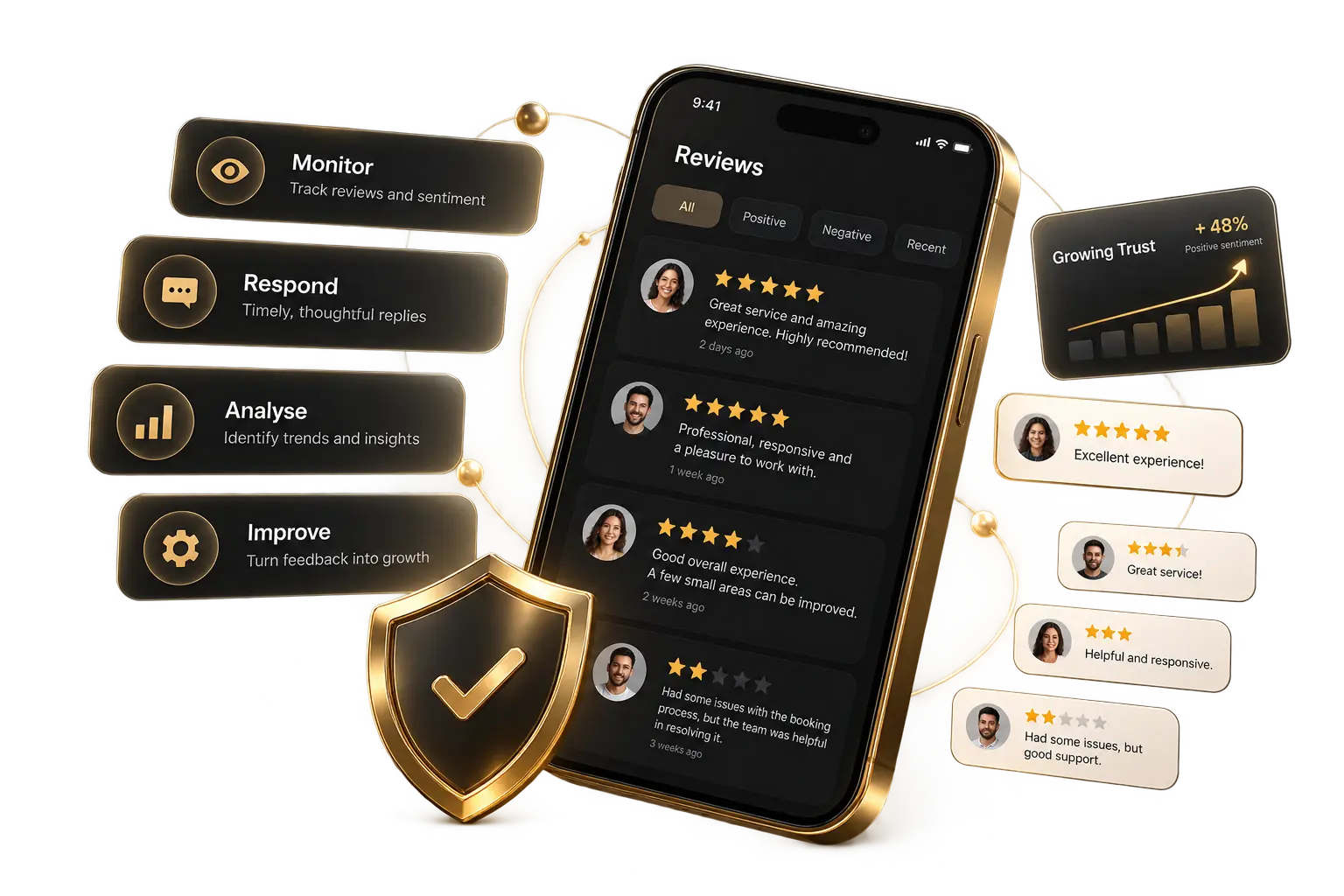
Your reputation exists whether you manage it or not.
Customers increasingly encounter a business through public feedback before they ever speak to the business itself. Reviews, responses and recurring customer experiences all contribute to the story people form about your brand.
Reputation is more than a star rating.
Review Monitoring
Track new customer feedback, sentiment and recurring themes across the platforms that matter to your business.
Response Strategy
Create thoughtful, timely and brand-appropriate responses that communicate with clarity rather than sounding scripted.
Feedback Handling
Separate useful criticism, misunderstandings and policy issues so each situation receives the right next step.
Review Generation
Build ethical customer-feedback systems that make it easier for genuine customers to share their real experiences.
Reputation Signals
Identify recurring customer themes and understand what the feedback is revealing about the experience your business delivers.
Reputation Reporting
Turn review activity and customer sentiment into useful insights that can influence marketing and business decisions.
A reputation system should create a feedback loop.
Reviews are not simply something to collect or answer. They are customer signals. The right system listens to those signals, understands them and feeds the useful information back into the business.
Every response is public brand communication.
A response can reinforce trust, clarify an experience or show how seriously a business takes its customers. It should feel human, relevant and appropriate to the situation — not copied from a generic script.
Generic responses that acknowledge feedback without addressing what the customer actually experienced.
Acknowledge the specific experience, communicate where appropriate, offer a meaningful next step and keep private customer details out of the public conversation.
Not every negative review is a reputation problem.
The right response depends on what actually happened. Reputation management should not mean trying to hide every criticism. It should mean understanding what deserves a response, what deserves resolution and what genuinely violates platform policy.
Valid Feedback
Listen → understand → respond appropriately → improve the experience.
Misunderstanding
Clarify the situation, communicate respectfully and provide an appropriate path toward resolution.
Policy Violation
Document the issue and use the platform's appropriate reporting or appeal process when the review violates policy.
Reviews shouldn't end with a reply.
The real value of reputation management appears when customer feedback becomes useful information for the business itself.
Customer Experience
The experience creates the original signal.
Feedback
Customers describe what happened.
Insight
Patterns become visible.
Improvement
The business acts on useful signals.
Better Experience
Better experiences create stronger future feedback.
Reputation doesn't live on one platform.
The way customers perceive a business is shaped by multiple digital touchpoints. Reputation becomes stronger when those touchpoints communicate the same underlying standard of trust.
Google Business Profile
Reviews, local discovery and the first impression customers encounter in Search and Maps.
Website
Testimonials, proof, positioning and the experience customers encounter after discovering the business.
Social Media
Public conversations, customer interactions and ongoing community perception.
Customer Experience
The actual experience remains the foundation behind every meaningful reputation signal.
CRM & Customer Data
Feedback can inform follow-up, customer relationships and operational improvements.
Local SEO
Reputation works alongside broader local search visibility and customer discovery.
A better reputation should be measurable.
We look beyond a single rating and focus on the signals that help reveal what customers are experiencing, discussing and expecting from the business.
Review Volume
Understand how much genuine customer feedback is being generated.
Response Coverage
Track how consistently meaningful customer feedback receives an appropriate response.
Sentiment Trends
Identify how customer sentiment changes over time.
Recurring Themes
Surface patterns in praise, concerns and customer expectations.
Rating Trends
Observe changes in overall customer rating patterns over time.
Resolution Patterns
Understand which types of customer problems appear repeatedly.
Trust travels with your brand.
Reputation questions, answered.
Reputation management is the structured process of monitoring customer feedback, understanding reputation signals, responding appropriately and using customer insights to strengthen trust and the customer experience.
Not simply because a business dislikes a review. Reviews should only be reported for removal when they violate the relevant platform's policies. Our approach focuses first on understanding, responding to and learning from genuine customer feedback.
Yes. We can help design ethical review-request workflows that make it easier for genuine customers to share their experiences without manufacturing or manipulating feedback.
Depending on the engagement, we can support review-response workflows and response strategy. Any third-party review management should be carried out with the appropriate business authorization and access.
Strong reputation signals can contribute to customer confidence during local discovery. Reputation management works best alongside accurate business information, local SEO and a strong customer experience.
Depending on the business, measurement can include review volume, response coverage, sentiment trends, recurring themes, rating trends and patterns in customer issues.
Yes. Google Business Profile optimization focuses on accurate profile information and local discovery, while reputation management focuses more deeply on customer feedback, reviews, responses and reputation signals. The two services complement each other without having the same purpose.
Yes. Multi-location businesses can benefit from centralized reputation processes while still maintaining location-specific context, customer responses and operational insights.
Your reputation is already part of the buying decision.
Make sure the experience people find matches the business you want them to trust.